
Every online slot prints a return-to-player figure on its help screen, usually somewhere near 96%. Few players ever see what that number looks like in a real session, and almost nobody publishes the session itself. Slotester was built to do exactly that. Since September 2026 the site has been running popular slots on their makers' official demo servers, logging every spin and printing the results next to a free demo of each game, with the raw data open for download. This guide explains in plain language what the lab measures, how to read its pages and what its numbers can and cannot tell you.

What is Slotester, in one paragraph
Slotester, also known as Slotester Lab, is a slot testing website at slotester.com. Its automated test rig plays each game for thousands of rounds on the studio's own demo server, records every result and computes statistics such as measured RTP, hit rate, bonus frequency and the value of bonus purchases. A human editor checks each review against the spin log before it goes live, and every log can be downloaded with a checksum.
A lab, not a casino
Nothing on Slotester involves staking real money on the site itself. The demos embedded in reviews are loaded from the game studios' servers and run on virtual credits, with no sign-up required. The lab earns money in one way only: next to some demos there is a partner casino offer, and the lab may receive a commission if a reader registers through it. According to the site's affiliate disclosure, those links are marked as sponsored, appear only beside the demo player and cannot touch a measured number, a verdict or the order of games in the rankings. Game studios pay nothing and are not told which title is next.
Declared RTP versus measured RTP
The declared RTP is a design value: the share of all stakes a game is built to return over an enormous volume of play. The measured RTP is simple arithmetic on the logged rounds, total won divided by total staked. In a single session the two rarely match, and Slotester makes a point of showing by how much.
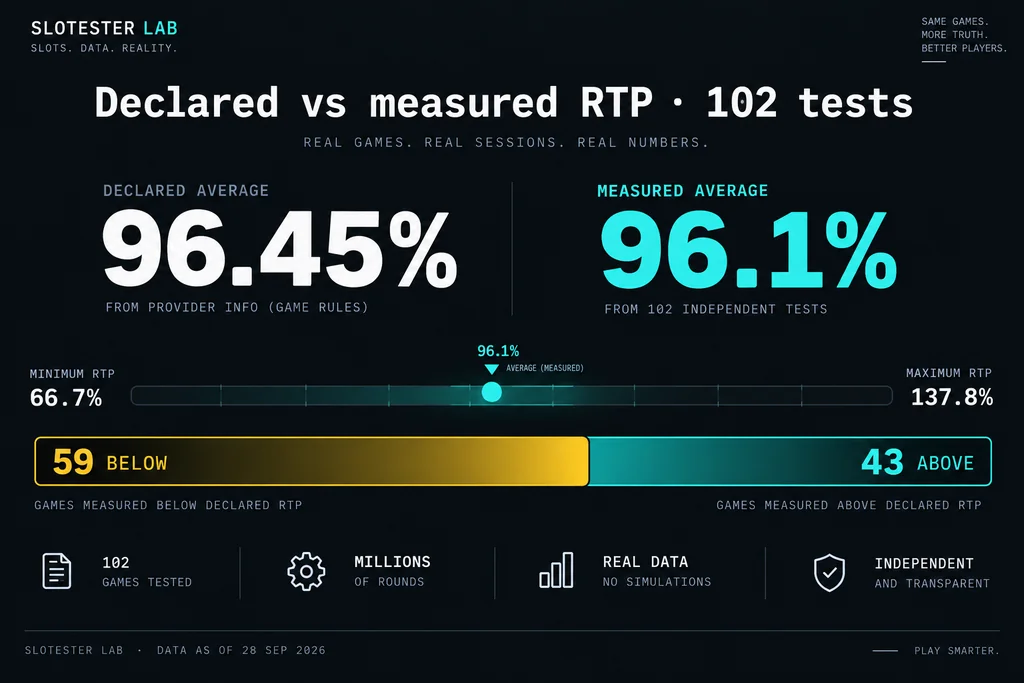
Across its first 102 tests the average printed figure was 96.45% and the average measured return 96.1%, a small gap. Inside individual tests the picture is far wider. The lowest result was 66.7% on Tombstone R.I.P and the highest 137.8% on Top Dawg$, two games whose printed figures sit within a couple of points of each other. Fifty-nine tests came in under the printed figure and forty-three over it, nearly half and half. The lab reads that as what fair games produce over finite runs, and it never presents one low result as proof that a game is set differently from what it says.
Why every figure comes with a range
Next to each measured RTP, Slotester prints an approximate 95% confidence interval. For a calm game with frequent small wins, one run pins the average down to within a few points. For a volatile game, where most of the designed return sits in rare rounds worth hundreds of bets, the same run leaves a band thirty points wide or more. Top Dawg$ is the extreme case, with a band from 48.6% to 226.9%. The printed figure fell inside the lab's band in 96 of the 102 tests, which is what correctly declared games should show. The lab adds a caveat worth repeating: the band describes how precisely the run measured the game, not what the next session will do.
How often do bonuses really land?
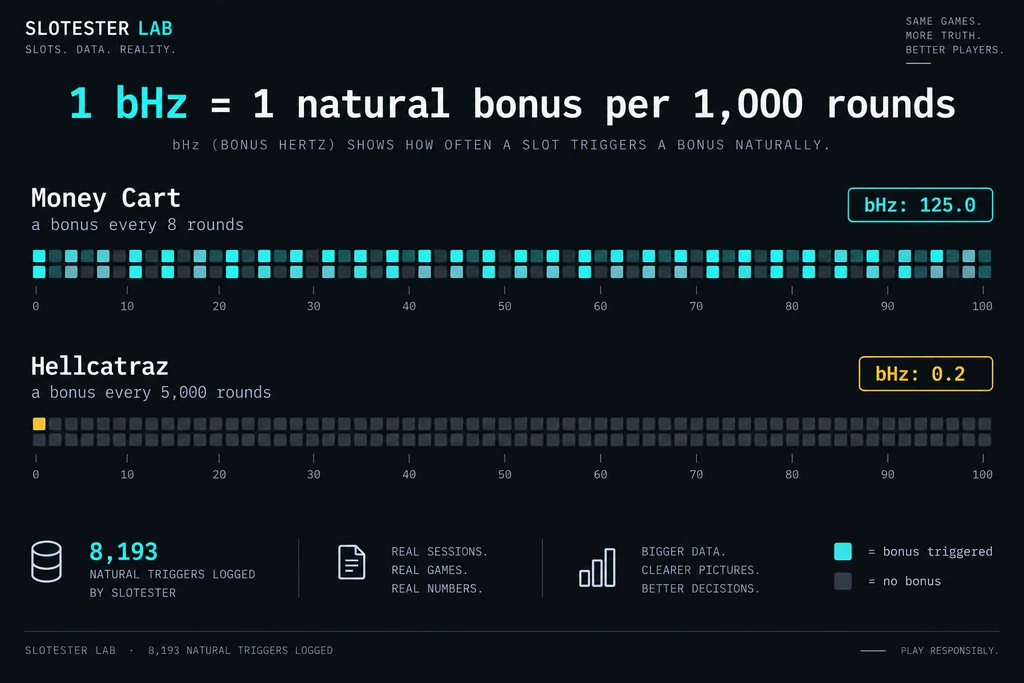
No slot tells you how often its free spins trigger, so Slotester counts. The site even coined a unit for it, bHz, meaning the number of bonuses a game triggers by itself in 1,000 ordinary spins. At 5.2 bHz, a feature turns up about once every 192 spins. Bought features are left out, so the figure describes the wait a player actually faces.
Across the lab there are 8,193 natural triggers: one every 159 rounds on average and one every 270 rounds for the median game. The extremes sit far apart. Money Cart triggered its feature 1,235 times in one run, about once every 8 rounds, while Hellcatraz managed roughly one in 5,000. The longest stretch without a bonus anywhere in the data is 4,563 rounds, and the median game's longest gap is 1,031. Frequent features also tend to be cheaper ones.
Is buying the bonus worth it?
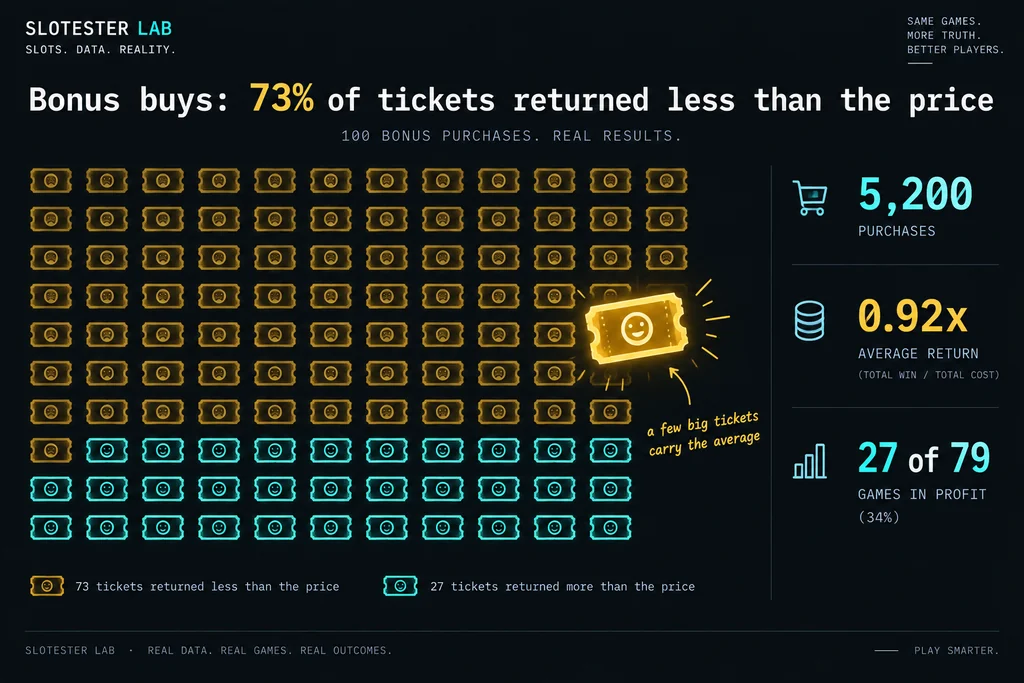
Many modern slots sell their feature for about a hundred times the bet. For every game that offers this, Slotester buys the feature a series of times at the listed price and records each ticket. Of 102 tested games, 79 sell a purchase, and the lab now holds 5,200 bought features. The average game returned 0.92 times the price, and 27 of the 79 games finished their purchase series in profit. The more telling figure is the single ticket: averaged across games, 73% of purchases returned less than they cost. A handful of big tickets carry the average, so someone who buys five features in a row is far more likely to see three losses and two modest wins than a smooth 92%.
How to read a Slotester review
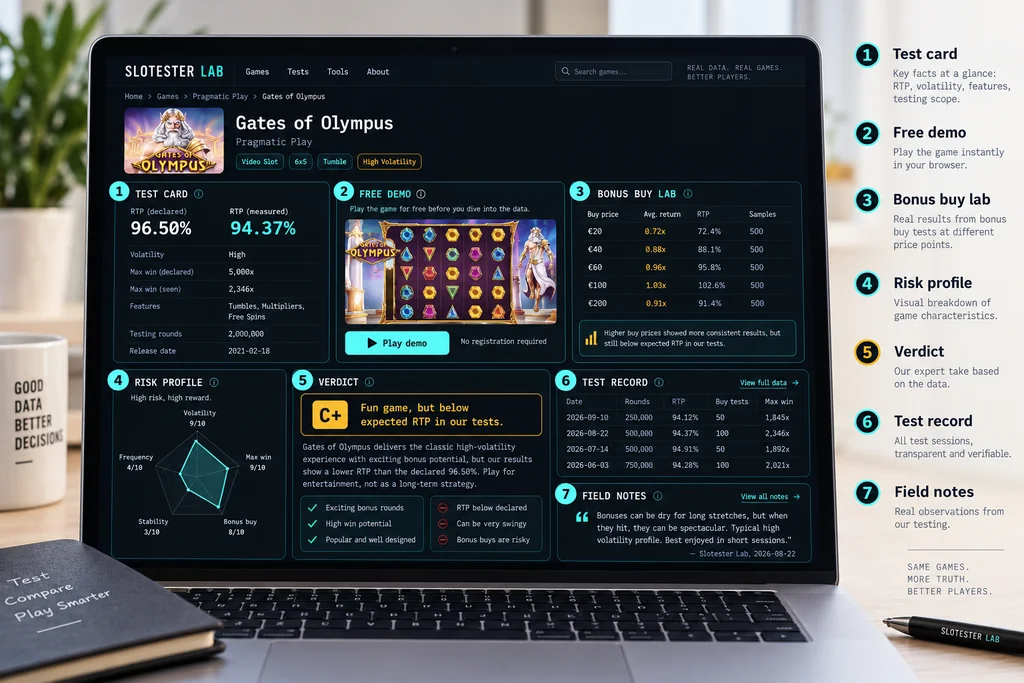
Every review follows the same order, which makes games easy to compare:
- Test card: measured and declared RTP, the interval, the number of rounds, the bet and the demo currency.
- Free demo of the game, loaded from the studio's server.
- Bonus buy lab: every purchased ticket as a multiple of its price, with amber marking the ones below cost.
- Risk profile: the longest dry run, the deepest drawdown and bankroll survival, meaning whether 50, 100 or 200 bets would have run out before the end.
- Verdict, written from the log rather than from impressions.
- Test record: each run with its own numbers, a dated note and downloadable files.
- Field notes: a public thread where readers describe what the game did in their own sessions.
A worked example: one test card
Big Bass Bonanza, one of the best-known fishing slots, shows how much a single card says. The lab has run it three times, 30,000 spins in all at a bet of USD 2.00, and the game has no buy button, so every bonus on its card arrived naturally. The declared RTP is 96.71%. The measured Big Bass Bonanza RTP is 86.41%, with an interval from 78.6% to 94.3%, so the printed figure sits just above the band, a rare case in the lab's data. The three runs returned 81.19%, 96.83% and 81.23%. Only 13% of spins paid anything, about one in 7.74, but the median winning spin returned 2.00 times the stake, so a typical hit pays about twice the bet. The longest run of empty spins was 54. The best base-game hit was 200.5 times the bet, in run 1 at spin 2,046. Free spins arrived 251 times, a rate of 8.4 bHz or roughly once every 120 spins, averaged 55.6 times the stake and collected 643 fish along the way. Read together, the card describes a game with rare but decent base hits, frequent free spins and a set of runs that came in below the printed figure.
Four rankings built from measurements
Beyond single reviews, Slotester sorts all tested games in four ways. Best RTP ranks them by measured return, with the declared figure alongside. Best Bonus ranks them by what bought features returned per unit of price, with natural triggers counted next to it. Max Win ranks them by the biggest single round in the logs against the advertised cap; the top entry, Top Dawg$, reached 18,146 times the bet against a cap of 25,014. Free Spins ranks them by how often the feature started on its own. No ranking can be bought, and new tests join each list as soon as they are published.
The Research section reads across all the tests at once. Its first reports cover declared versus measured RTP, bonus purchases and free spins frequency, plus a step-by-step account of one complete test. Their tables recalculate from the current data each time a page opens.
Who the site is for
The obvious audience is the curious player who wants to know how a game behaves before spending anything on it: how long the dry spells run, how often the bonus comes, what a purchase tends to return. A second audience is publishers and affiliates who repeat RTP claims and would rather quote a measured, dated figure than a brochure. A third is anyone who works with data. The logs are released under a Creative Commons Attribution licence, so researchers can reuse them with credit, and every figure on a review page can be traced back to a specific round.
What Slotester will not tell you
The lab is blunt about its limits. It does not predict when a game will pay, it does not settle casino disputes and it does not hand out bonus codes or betting systems, because no strategy changes a slot's return. Its tests run on demo builds, so it cannot see which RTP version a particular casino offers. Many games ship in several versions, and a casino running a 94% build should be expected to return less. Every page carries an 18+ notice and points readers to help services such as BeGambleAware and GamCare.
Quick answers
Is Slotester free to use?
Yes. Reviews, rankings, demos and log downloads are free, and no registration is needed to read them.
Who is behind Slotester?
Reviews are signed by Slotester Lab rather than by named personas. Software runs the tests and drafts the text, and a single responsible editor checks and signs off each review.
Can I check the numbers myself?
Yes. Each run links a CSV of its rounds with a SHA-256 checksum, and dividing total wins by total bets reproduces the measured RTP.
Does Slotester test every slot?
Not yet. The rig reads the demo servers of Pragmatic Play, BGaming, Relax Gaming, Nolimit City and Quickspin, including Big Time Gaming and Push Gaming titles hosted on the Relax server. Readers can request any of their games that has a public demo.
How can I contact the lab?
Corrections, test requests and press questions go to [email protected]. The site has no social accounts, chat widget or phone line.